Total Pageviews

Showing posts with label Historical Mystery. Show all posts

Monday, September 5, 2011

Children's Book and Murder Mystery Author Marilyn Levinson Reveals New Book, A Murder Among Us

I’m a former Spanish teacher, and the author of several books for children and young adults. A Murder Among Us is my first published adult mystery. My novel, Murder A La Christie, was a finalist in the 2010 Malice Domestic contest. I’m a member of The Authors Guild, RWA, The Mystery Writers of America, Sisters in Crime, and the Guppies.  I am president, and co-founder of the Long Island chapter of Sisters in Crime. I live on Long Island with my husband, Bernie, and our cat, Sammy.
Tell us about the genre of your work. 

A Murder Among Us is a traditional mystery with cozy elements.  The novel debuted in June it was published by Wings ePress, and soon will be available in paperback.  Ebook ISBN: 978-1-61309-014-5; POD ISBN: 978-1-61309-981-0
Why did you choose this genre?
I chose to write in the mystery genre because I love puzzles.  I also love delving into personalities:  who, among all the characters in the story, is evil or amoral enough to have murdered one, two, or three characters?  In cozies and traditional mysteries, the murderer and victim often know each other, which makes it more interesting.  Also, each character has his or her secret.  I love unraveling secrets.
What are some of your books, stories that have been published? 
My first published novel for children was And Don’t Bring Jeremy (Holt).  It’s about two brothers, Jeremy and Adam Krasner.  Adam, the younger brother, is often embarrassed by Jeremy, who is neurologically impaired.  In the course of the book, Adam learns that while Jeremy can’t play baseball, he has certain strengths that merit his admiration.  And Don’t Bring Jeremy was a nominee for six state awards.  It’s out of print, but I intend to bring it out as an ebook. 
No Boys Allowed  has been in print since 1993, and has sold over 200,000 copies.  When Cassie Landauer’s dad leaves the family to marry a young lawyer in his firm, she declares war on all males, including her best friend, Bobby.  Then Great-Uncle Harry moves into the house and discovers Cassie’s working on her dad’s old stamp album.  Eventually, Cassie must allow boys and men back into her life, and that includes her father. No Boys Allowed! ISBN 0-439-71965-8 It is available through Scholastic and Amazon.com.
Rufus And Magic Run Amok is about fourth-grader, Rufus Breckenridge, who discovers he’s a witch.  While he’s happy to now have the power to  deal with Big Douggie, his tormentor, Rufus won’t tell his parents he’s a witch.  If he does, he’ll have to take boring lessons to control his powers.  And so his magical powers run amok. Rufus And Magic Run Amok was selected by the International Reading Association, and the Children’s Book Council for “Children’s Choices for 2002.”   Currently, it’s out of print, though I intend to make it available as an ebook 
How do you come up with the names of places and characters in your books?

I set my books on Long Island, where I live, though the towns and villages in my books don’t really exist.  I create my characters, as well.  They aren’t based on real people.

How did you develop the character of your protagonist in this book?

Lydia Krause is the sleuth in A Murder Among Us.  She’s 58, attractive and vibrant, and was the CEO of her own company.  She is also a widow and the mother of two adult daughters.  I created a bright and savvy sleuth who has start a new life, which Lydia does when she moves to Twin Lakes, an upscale retirement community.

What about an antagonist…is there a unique “bad guy” or a recurring nemesis of any kind?

My nemesis butts heads with Lydia. She exposes his past in a very public and emotional scene in the clubhouse.  Marshall Weill’s a slick conman who has been to prison for embezzlement.  He’s also a womanizer, and Lydia holds him responsible for her youngest sister’s suicide.  But when Weill is accused of having committed two murders, Lydia offers to find proof that he’s innocent of homicide.

What’s your favorite thing about your book?
I love Lydia’s relationship with Detective Sol Molina.   At first she’s his Suspect Number One, but they’re attracted to one another.  I also love Lydia’s relationship with her daughters and how she handles the extra-marital affair of one and the wedding plans of the other.
How is writing in the genre you write, different than other genre?
Once I’m in the head of my main character, be it a ten-year-old boy or a forty-eight year old college professor, the voice comes alive and the elements of that particular story fall into place.  One big difference: in my mysteries, I always have a romance going.  And my adult characters have emotional baggage and several secrets they try to keep hidden.  My child protagonists have to deal with a particular problem, which they eventually solve without their parents’ intervening.
Why and when did you begin writing?
Would you believe, I started writing in the second grade?  I still have my notebook of little stories.  Being a Trixie Belden, Nancy Drew, and Judy Bolton fan, I started my own mystery, but never got past chapter one.  No doubt, because I hadn’t worked out the plot.
What is your writing schedule?
I write best in the afternoon.  I find I start producing pages at a quarter to three.  Don’t ask me why.  Perhaps that’s when--in the past--I’d arrive home from teaching.  But I do my best writing when it’s time to prepare dinner.<g>
What projects are you working on now, or plan for the future?

I’m finishing up a mystery now, a sequel to Murder A La Christie called Murder The Tey Way.  After that, I’d like to write another Lydia Krause/Twin Lakes book, or one with my ghost, Cameron Leeds.  The first mystery with Cam will be coming out in the spring of 2012 with Uncial Press.
What kind of advice or tips to you have for someone who wants to write and get published?

Long Island Sisters in Crime meeting in Dec. 2010
Join writing organizations that are geared toward the kind of book you write.  Take writing classes, at least to begin with.  Form a critique group.  Read what you write; read what you don’t write.  Above all, WRITE!!
Are there any other comments, advice or tips that you would give to beginning writers?
Learn to listen to criticism, but develop a sense of what’s right for the book you’re writing.
What do you do when you are not writing? 
I read, knit, email friends, go out for dinner with my husband, see friends, exercise, walk, and think about my work in progress.
What “Made It” moments have you experienced in life?
Reading a great review of And Don’t Bring Jeremy, and seeing one of the book’s illustrations in Publishers Weekly.
Attending my son, Michael’s, wedding last May.
Co-founding the Long Island Sisters in Crime chapter
Being recognized by children’s librarians as “that” Marilyn Levinson
Avery Aames and me
--at Malice, 2011.
Avery won
Best First Novel Agatha award
Visit her website www.MarilynLevinson.com and find out where you can purchase A Murder Among Us and other books.
This is photo of me (in the center) with fellow Guppies
 Jeri Westerson, Liz Zelvin, Gloria Alden, and Kaye George
 at this year's 2011 Malice Domestic convention's banquet.


Monday, August 22, 2011

Visiting with Prolific Author/Writer, Joseph R.G. DeMarco and His New Book, Murder on Camac

I grew up in South Philadelphia, which was the Little Italy of Philadelphia at the time. The Godfather could just as easily have taken place here as in New York. That part of the city still retains some of its Italian flavor, but recent years have seen great changes there. The diversity in the area, with the influx of new groups, is wonderful and means that South Philly will remain vital. I am eager to see just how the neighborhood will work its changes on the new arrivals and how much they will change the tone of that area. Growing up there definitely gave me a certain perspective on life, as did my Italian roots. It shows up in my work and in choices I make in some of that work.

My Catholic school education gave me yet another way to look at the world.  I can never forget the priests and nuns who were a major influence in my formative years. Of course, the Church itself made a lasting impression and maybe that is why my first mystery novel, Murder on Camac, centers around a years-old controversy in Papal history.

After university and an almost PhD in PoliSci/International Relations, I went into teaching for a while. I decided that I wanted something different and returned to school for a second Master’s Degree in Information Science. That led me to work as the head librarian in a prep school, which was an education in itself. I had always had respect for librarians, but never so much as after I had begun working as one.

Coming out was another major event which gave me yet another perspective on life and the world. Things are still difficult for people even now, so I feel privileged being able to live honestly and authentically and to be able to work for improvements in the community at large. The writing I do has most definitely influenced by this aspect of my life.

My training as a writer went on concurrently with all the other education and beyond that. That training is a combination of formal lessons and workshops and “on the job” learning. I have studied writing at various universities and in private workshops. I have improved my playwriting skills at different theater schools – one notable institution; the HB Studio in New York was a stunningly wonderful experience. I have also had the good fortune to have been invited to participate in serious workshops such as the Prague Summer Writing workshop (which may have a different name these days). Spending several weeks in that city learning at the feet of great writers was something I will never forget.

All along the way I kept writing and getting published in a variety of newspapers and magazines including: The New York Native, The Philadelphia Inquirer, The Philadelphia Gay News (PGN), The Welcomat, KLIATT, Chroma, Il Don Gennaro (a national Italian-American magazine), and a number of other publications. I also worked as a columnist for The Advocate, In Touch, and Gaysweek.

In 2004, I took the reins at Mysterical-E (a magazine dedicated to mystery and the mysterious) which had already been around for about nine years. The first issue under my editorship was launched in March 2005 and we have been publishing quarterly ever since at http://www.mystericale.com

Though my literary tastes are varied, I tend toward mystery, science fiction, fantasy, and other genres. I do read more widely than that, however, including literary fiction and plenty of other forms. Right now, however, I am steeped in research for a book and will be doing some nonfiction reading. I enjoy history, especially material having to do with people and events that are not as widely known but often more significant than some we know well.

Tell us about the genre of your work. 

Both my most recent works A Body on Pine and Murder on Camac are mysteries. I do write in other genres as well as doing some nonfiction, but these latest works are in the mystery category. They take place in Philadelphia and feature a gay detective who has a complicated life.
I have also edited an anthology that came out June, called A Study in Lavender, and are tales set in the world of Sherlock Holmes with a gay twist.

Why did you choose this genre?

My reading and writing tastes run the gamut from science fiction and fantasy to the various subgenres of each (especially alternate history and time travel) to mystery. Since I was a kid mysteries have fascinated me. Maybe, I chose it, because there is something mysterious at the center of everything. There is usually something that we have to dig for and strive to understand before things make sense.

Secrets, things done in the shadows, plots conceived in back rooms all have consequences that may or may not have been anticipated. People are affected, crimes are committed, and this inevitably sets in motion a search for what is really going on and why.

Mystery novels begin with a world out of order (or soon to be thrown into chaos), with people in need of someone to set things right by finding the truth and delivering justice or what may pass for justice. The detective or sleuth often has to go to some dark places to find that truth and some of those places are within himself. I like the idea of making order out of chaos, of turning over hidden things to get at the Truth, of seeking justice, of being able to comment on things around you through the eyes of the characters.

There is a lot of satisfaction in coming upon a situation and being able to do something to make it right, or at least to stitch things back together so that not everything is lost. That is the role of the sleuth, whether he or she is a private investigator, a police officer, or an amateur sleuth. They are people driven by the search for the truth, by a need to set things right, and by a desire to make the world whole again, even if it is only their small part of the world.
What are some of your books, stories that have been published?

Some my stories that have been anthologized are:

“Great Uncle Ned” appears in Charmed Lives, it is a ghost story and one of which I am particularly fond.

Scars” was included in Heat of the Moment, and was published in e-format in May.
 
“Adventurous Italian” in Men Seeking Men, is based on something that happened to me but it is embellished, of course.

More stories of mine, “Enthralled” “Arriverderci” and “Model Behavior” appear in each of the three volumes of the Quickies series.

My essays have been published in anthologies including Gay Life (Doubleday), Hey Paisan!(Guernica), Paws and Reflect (Alyson), Queer and Catholic(Taylor & Francis), and others.

Being a serious student of sociological issues, my work is published in a variety of academic venues including an article in The International Encyclopedia of Marriage and Family (Macmillan, 2002), two articles in the Encyclopedia of Men and Masculinites (ABC_CLIO) and articles in The Journal of Homosexuality (Haworth),  The Gay and Lesbian Review Worldwide, and others.

My article, “Gay Racism,” which first appeared in PGN, won the Best Feature writing award from the Gay Press association, and was subsequently anthologized in We Are Everywhere, Black Men White Men, and Men’s Lives. 

Could you tell us more about your books, and where they may be found.

A Body on Pine (ISBN: 978-1590213452) http://tinyurl.com/3ovabya or at

When Marco Fontana enters his friend's spa on Pine, he does not find the peaceful retreat he expected. Brad, the masseur, is missing. The spa is splattered with blood and a dead client lies sprawled on the floor. After a thorough search turns up more questions than answers, Marco calls the police. They find Brad's body a short distance from the spa and before long Marco understands that what appears to be a simple case of murder is anything but. The police want Marco off the case. However, when the body of a popular journalist is added to the death toll, Brad's case is sidelined. Marco refuses to allow his friend's death to be ignored and convinces an overwhelmed young police detective to bring Marco into the hunt for the killer. He finds plenty to keep him busy. Abusive ex-boyfriends, stalker clients, politicians, scheming businessmen, and Eastern European mobsters swirl together in a dangerous mix, which finds Marco in some of the most serious trouble he is encountered so far. Life at home does not stop for Marco, either. While he searches for Brad's killer, Marco's stripper troupe, StripGuyz, brings him face to face with a stripper's abusive boyfriend and, with Jean-Claude, a new member of the troupe who innocently comes between Marco and Anton, upsetting the fragile balance existing between them.

Murder on Camac (ISBN: 978-1590212134) http://tinyurl.com/3o34987
When author Helmut Brandt is killed in an apparent mugging, Brandt’s partner, who suspects this was premeditated murder, hires P.I. Marco Fontana. Brandt's work on the death of Pope John Paul I angered people in and out of the Church and made him more than a few enemies. His death happens soon after Brandt claims to have incontrovertible new evidence implicating people never before suspected. Fontana does not believe in coincidences and takes the case. A former Catholic himself, he knows that uncovering Brandt's killer means more than exposing a thirty-year old plot to kill the Pope: it could also ruin the people named in the documents Brandt is supposed to have. Of course, if Brandt's enemies have killed once over this information, they will not hesitate to murder a P.I. who gets too close to the truth. Entering the arcane world of the Catholic Church, Fontana encounters forces determined to keep him from getting to the truth.

Camac_street --- Camac is the Street where
the murder in Murder on Camac took place.
 One of the beautiful, tree-lined "tiny" streets
 in the Center City area of Philly.
Though he manages to gain access to the upper levels of the Archdiocesan hierarchy, Fontana realizes that the web of power and deceit is every bit as intricate, tangled, and deadly as he imagined. As the owner of StripGuyz Fontana, which has a troupe of male strippers, is no stranger to the seamier parts of the Philadelphia gayborhood. However, in this case, he finds that there is an even murkier side to life in the city of Brotherly Love.
You can find my website at: http://www.josephdemarco.com

How do you come up with the names of places and characters in your books?

I think most writers consider finding the right names an important part of creating each character, even the minor ones. After all, you put a lot of work into bringing a character to life in every aspect, so the name is more than just a pretty finishing touch. It says something about the character and who he or she is. Naming my characters takes a long time and often changes as the work progresses. I do a lot of research into names, the cultures they come from, the era in which they are most prominent, and more. For me, a character’s name means something beyond the supposed meanings of the names themselves. It has to be right and sometimes, in the middle of a book, I realize that a character has a name that does not really fit for any number of reasons. So the search commences again and a new name is found.

Sometimes this causes small problems that ripple through the manuscript – like making sure every instance of the name is changed or that nicknames match the new name. However, those things are small when you know you have the right name for that character.

How did you develop the character of your protagonist in this book?

Marco Fontana was with me for a long time before he took form on paper. In fact, apropos of the question above, Marco used several names before I realized his name was Marco Fontana. I will not go into all of the names but suffice to say they were all great; they just were not his name.
 
It took a while discovering who Marco is as a person. I hardly knew Marco when he showed up a long while back. I only knew that he was a character I wanted to know more about. I wanted to know what kinds of life he had and what kinds of adventures he would get into. I knew I wanted to write mysteries, what I did not know was that Marco would be at the heart of them. Maybe he knew that before I did. Whatever the case, he hung around until I noticed him and discovered what a wonderfully interesting person he is and how exciting he could be. He is still evolving and revealing himself, like any person. Each work in which he appears shows a different facet of his personality or deepens other things about him.

What about an antagonist…is there a unique “bad guy” or a recurring nemesis of any kind?
The antagonists in my Marco Fontana mysteries are all different. Each new book or story brings another antagonist front and center along with a new set of problems. Often they play off things about Marco or his life and help to reveal more about him as a person while they place themselves in the spotlight as well.

The idea of a recurring nemesis is appealing and that may develop at some point in the series.
Marco does have a longstanding problem, which is a nemesis of sorts. It is a case he has never been able to solve and it nags at him. That case is always on his mind and at some point; he will get to tackling it. Whether he will solve it or not is open to question. I know he wants to.

What is your favorite thing about your book?

I suppose there are two things, the characters and the world they live in. I see it and feel it. I know it well and not just because it is based on Philadelphia. I know it because I have remade the city in some ways to include some of the things I want to see here. There are places and institutions I have placed here in Center City Philadelphia which do not exist (yet) but which should. These places, like the fabulous gym complex, Olympus, do not change the character of the city. They grow naturally from what the city is, from the city’s character, and from what it could/should be like if money and vision converged.


How is writing in the genre you write, different than other genres?

Every genre has its conventions. You do not have to adhere to all of them but readers stick with a genre because they like what it has to offer.

Though mystery is not the only area in which I write, it is a major part of my writing life, and so I think in terms of mystery and the mysterious in just about anything I do. Let us face it, everything either has some mystery to it or would be better if it did.

We never know everything about anyone, even our closest friends, even our relatives. Bingo! Mystery. We never know all the intricate details of every place we visit, every institution we deal with. Again, bingo! Mystery.

In some ways all genres have, if not a mystery to solve, a certain tension or question which the readers’ want answered. Will the protagonist reach his/her goal? Will the antagonist win? Will any number of subplots come to a satisfactory resolution? All, in their way, questions that the reader wants answered.

Why and when did you begin writing?

Telling a story has always been important to me. I grew up around some amazing storytellers and often met people who could also tell stories, including my late partner. They had family tales to tell, tales that were legends and family myths and they told them with verve. Of course, growing up Italian, life is drama, an operatic drama at times. Therefore, you cannot help but absorb not only the stories and the drama, but also the need to tell those stories.

I have also always had rich and colorful dreams and fantasies. I guess you could call me a daydreamer. These were fed by reading and television. I loved immersing myself in the world different authors created. I knew that I wanted to be able to create fantastic worlds, mysterious situations, epic tales, and more, just like my favorite authors.

What is your writing schedule?

Don’t ask. (But you did, so I guess I should say something.) I am best on a deadline. It focuses the mind. So, I try to give myself deadlines over and above the deadlines I have from publishers and from the magazine I run. When on deadline, I try to set aside as much time as I can to do research, to write, and to revise. Even just having a goal without a deadline is a good way to focus and work. There is something to reach for and achieve.

What projects are you working on now, or plan for the future?

I am just finishing the edits on the anthology I mentioned: A Study in Lavender.

At the same time, I am working on a number of projects: two of them are the third Marco Fontana mystery, and a book that will come out between the second and third Fontana books, which is a collection of tales or early Fontana investigations, including some tales that show how he became Marco Fontana, P.I.

There are other projects, which are being planned and researched and some of which I have already started writing.

What kind of advice or tips to you have for someone who wants to write and be published?

The best advice: Read and Write, then submit what you write, then read and write some more.
Are there any other comments, advice or tips that you would give to beginning writers?

Have patience when you send things to publishers.
Follow guidelines and do not second-guess publishers and editors.
What do you do when you are not writing?  

Are there times when a writer is not writing? I don’t really think so. Every step we take, every place we visit, and each person we interact with are all stored in memory. Whatever we read, watch, or hear all become a part of us, and eventually a part of what we create.

So, really, I am never not writing. I am always thinking about writing, characters, or situations, about plots and twists and turns. However, when I’m not actually at my computer, I’m reading, researching, making notes, watching TV, taking walks, dining out, being with friends. 

Two important things are reading and researching.

Reading is an important part of being a writer, so I try to set some time each day for reading. I sometimes have to tell myself to just read and enjoy but that is not always the case. I am sure all writers notice that their reading habits change as they grow and the way they read changes as well. I find myself reading with a different sensibility: as an editor and as a writer trying to learn something about writing and style.

When I was a child, I was a voracious reader. I read for the sheer joy of entering another world and time. I lost myself on other planets and in other timelines. I spent time in English manor houses trying to puzzle out murders and on starships exploring the galaxy. Those were wonderful times, some warm and comforting moments. Just my books and me. I remember curling up in cozy spots around the house and immersing myself in the world of the books I was reading. There were not too many distractions and I could easily drift into the world each author created. I realize now that I was reading with joy and not as a practitioner of the art.
What “Made It” moments have you experienced in life?

There are many moments like that. All the significant events in anyone’s life can be “made it” moments but for me there is one kind of moment that surpasses them all.

The usual moments for me include things like becoming an Eagle Scout. That was an achievement for a nonathletic kid such as I was. I had to do some athletic things I never expected I could, and some non-athletic thing I never thought I would. As they pinned that medal on my chest, I experienced a “made it” moment.

Holding my first mystery, Murder on Camac, in my hands, feeling the weight of the book and remembering all the work that had gone into it, and knowing that it was a reality, that was a “made it moment.”

When I graduated from Information Science school and had an unexpected job waiting for me, that was a “made it” moment. I worked hard at that degree, having gone back to school after teaching for some years. I took more courses than required and learned every aspect of the field. Marching down that aisle, I knew I had achieved something.

When I wrote an article for the local gay newspaper about racism in the gay community, it was nominated for a national award. My article was competing against some of the biggest names in gay publishing at the time. These were journalists with reputations. I felt I had no chance and decided it was not worth attending the awards ceremony. I later received an excited call from my editor that I had won. That article went on to be anthologized in three different collections. Definitely a “made it” moment.

The Gay Community Center
I helped found and which sits in the middle
 of the neighborhood
 where the action in
A Body on Pine takes place.
Of course, when various things I wrote got published: my first op-ed piece in a major newspaper, my first short story in an anthology, my first article in a nonfiction collection, the first time my work was placed in an encyclopedia. These were all “made it” moments. I am sure when I get the copies of my latest, A Body on Pine, that will be another “made it” moment.

After all the other made it moments, there are special ones that mean the most to me and which I never talk about.


Murder on Camac (ISBN: 978-1590212134) http://tinyurl.com/3o34987

A Body on Pine (ISBN: 978-1590213452) http://tinyurl.com/3ovabya or at

Find out more about this author.


Friday, July 29, 2011

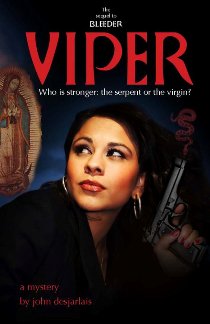
John Desjarlais' New Book, Viper, Sequel to Bleeder Released June 2011

A former producer with Wisconsin Public Radio, John Desjarlais teaches journalism and English at Kishwaukee College in northern Illinois. His first novel, The Throne of Tara (Crossway 1990, re-released 2000), was a Christianity Today Readers Choice Award nominee, and his medieval thriller, Relics (Thomas Nelson 1993, re-released 2009) was a Doubleday Book Club Selection. Bleeder and Viper (Sophia Institute Press, 2009 and 2011 respectively) are the first two entries in a contemporary mystery series. A member of The Academy of American Poets and Mystery Writers of America, he is listed in Who's Who in Entertainment and Who’s Who Among America’s Teachers.


Tell us about the genre of your work. 
I am currently writing a contemporary mystery series featuring an amateur sleuth and a former DEA Special Agent, but I have written historical novels with a crime element before. I teach a course in Detective Fiction at my college, and so it is fun to be writing in the genre also.
Why did you choose this genre?
I fell into it quite accidentally. I was writing historicals, and I had an idea wherein Aristotle, the Father of Logic, would solve a crime. Detective fiction is all about the celebration of reason, and I thought this had great possibilities. I learned early in the research, though, that a British writer already did this – and rather well – so my thinking took a turn.  I conceived of a classics professor who would be conversant in Aristotle’s works, so much so that Aristotle would be his ‘mentor’ or ‘sidekick,’ solving a seemingly irrational mystery. The result was BLEEDER.
What are some of your books, stories that have been published?
The Throne of Tara (Crossway 1990; reissued iUniverse 2000, ISBN 0-595-15597-9)
Relics (Thomas Nelson 1993; reissued 2009, ISBN: 0840767358
ISBN-13: 9780840767356)


Bleeder (Sophia Institute Press 2009, ISBN: 978-1-933184-56-2)
Viper (Sophia Institute Press June 2011, ISBN: 978-1-933184-80-7)
I have had many short stories published in literary journals; the most recent include “Assisted Living” in Dappled Things and “Lovebird,” scheduled for the summer edition of The Rockford Review.
Give a short description of each and where they can be found.
The Throne of Tara, set in Dark Age Ireland, is based on the dramatic true story of Saint Columba of Iona, the hot-headed monk who went to war over a book, and in remorse over the thousands slain, exiled himself among the Picts of Scotland where he dueled the Druids, miracles versus magic.
Relics is a medieval crime thriller set largely in Crusader Palestine, involving a suspicious cathedral fire, a stolen relic, and a terrorist plot to assassinate King Louis IX of France.
Bleeder is a contemporary mystery where a stigmatic priest collapses and dies on Good Friday in front of horrified parishioners. A miracle? Or, bloody murder? Classics professor Reed Stubblefield applies Aristotelian logic to learn the truth, since police regard him as a prime person of interest. But, not everyone in this little town wants the mystery to be solved.

Viper is the sequel to Bleeder, in which Latina insurance agent Selena De La Cruz – a minor character in Bleeder - learns her name is in her parish church’s All Souls Day, Book of the Dead. The problem is, she is not dead. However, someone wants her to be. Is it “The Snake,” an ambitious drug dealer she helped to arrest years ago when she was a DEA Special Agent, or someone far, far more dangerous?
You can see fuller story summaries at my web site, http://www.johndesjarlais.com/. My blog, “Johnny Dangerous, is at http://jjdesjarlais.blogspot.com/


How do you come up with the names of places and characters in your books?

For the historicals, I do research to make all the settings and their names authentic. Derry and Tara are real places in Ireland; Acre and Aigues-Mortes are real Mediterranean ports. Some of the characters are real historical figures that I bring to life through research and, where needed, an informed imagination. Therefore, in Tara, Columba is a fully realized historical personage, as are his mentors and companions in Relics.  I have re-created King Louis IX using biographical material from contemporaries. Other characters are the sorts of people you would find in that time period, so, like the real historical figures, I do research about them. I work hard to make the monks, warriors, washerwomen, serfs, kings, craftsmen, lords and ladies accurate.
My mysteries are set in rural Illinois. The towns are composites of real places in northern and northwestern Illinois, around the Sterling-Dixon area. Sterling becomes “Sterling Falls,” for example. “Prophetstown” is a real town and the name is too cool to change. As for character names, Bleeder’s protagonist “Reed Stubblefield’s” name is derived from harvested cornfields in Illinois – stubbled fields where the leftover stalks remind me of the verse in Isaiah  42:3 – “A bruised reed He will not break, and smoking flax He will not quench; He will bring forth justice.” Selena De La Cruz’s name comes from the Spanish mystic and poet, John of the Cross (de la Cruz).
How did you develop the character of your protagonist in your latest book?
When insurance agent Selena De La Cruz walked onto the stage of my first mystery Bleeder in those cherry heels, with that attitude and driving that fast car, I knew she had a story of her own. For the moment, however, I only needed her to handle the insurance problems of my protagonist, Reed Stubblefield. In addition, I wanted a positive portrayal of an educated Latin character, since the story had a background involving the flood of illegal Mexican immigrants in rural areas. That is all I wanted from this minor character. However, Selena insisted on having a larger role than I had anticipated.
The sequel, Viper, began with the idea that a Catholic church’s, Book of the Deceased, the ledger of the parish’s dearly departed put on display on All Souls’ Day, would have names of people still alive – but getting killed in the order in which they were listed. I learned early that Mexicans celebrate a holiday nearly concurrent with this, called “The Day of the Dead,” a fiesta with flower garlands, sweet breads and home altars to honor deceased relatives, candy skulls for the kids, and family picnics in cemeteries. It was obvious that Selena’s name would be on that list (the last name, I decided), and that she would be the protagonist.
This frightened me half to death. How could I, an Anglo guy in his 50s, presume to present a 30-something second-generation Mexican-American woman?
It wasn’t that I had not written from a woman’s point-of-view before. I had done so a few times in earlier novels, but in shorter scenes. This called for a sustained, novel-length treatment that was credible and compelling.  I wanted to be sure I got all the cultural material right and I was respectful with it. So much could go wrong.
Therefore, for nearly two years I became a second-generation Mexican-American woman.
Well, not literally. Vicariously, I guess you would say. I immersed myself in many books written by Latinas about coming to terms with Old-World expectations placed upon women while trying to fit into New-World American society (there are quite a few books out there on this subject, reflecting the growth of this population). I took careful notes, as with any other research I had to do for VIPER -- DEA undercover operations, police interrogation techniques, snake handling, Aztec religion and so on. I subscribed to Latina magazine for fashion, beauty, relationship and lifestyle issues. I paid attention to any news related to this community, especially immigration issues. I browsed Latinas’ blogs and web sites to see what everyone talked about, especially with regard to living with a bi-cultural identity. Just like the Dad says in the movie Selena, “We've gotta be more Mexican than the Mexicans and more American than the Americans both at the same time. It's exhausting!"  
I interviewed Latinas and I noticed things that were common to them all that I could easily adapt and make my own – well, Selena’s own. I built a very thorough backstory – life story – for her based on all this research. I had pages of notes and stacks of cards that I browsed through obsessively to remind myself of small details that were of possible use as ‘bits’ in the story or for possible flashback scenes.
What about an antagonist…is there a unique “bad guy” or a recurring nemesis of any kind?
No, there is no Blofeld or Professor Moriarty in the series. My generic antagonist/villain is someone who is the hero of his/her own story, someone who is trying to do (what they think is) the right thing but in the absolute wrong way. That is what ‘evil’ generally is all about.
What is your favorite thing about your newest book, VIPER?
It is the heroine, Selena, a feisty and fiercely independent Latina who is tough and tender, comfortable in overalls and boots one minute and a taffeta dress and killer heels the next, who has a temper when it comes to injustice but patience with those in trouble. I find her struggle to live with a bicultural identity fascinating and her effort to live in a man’s world admirable.
How is writing in the genre you write different from other genres?
Readers of mysteries are intelligent and savvy about the genre’s conventions. They read widely and voraciously; they pay attention to detail. They expect the traditional ‘puzzle’ mystery writer to ‘play fair’ with clues such that one can guess the culprit and yet be delightfully surprised at the end. Absolutely everything in the plot must fit logically. The characters must be strongly motivated and completely plausible, especially crime-solving professionals such as police and forensic lab scientists. You cannot make a mistake about crime scene processing or guns or fingerprint databases and so on. While the mystery affords itself to social comment and human insight, in the end the story must be an entertaining and page-turning yarn. In the literary debate about character-driven stories versus plot-driven ones, mysteries must be both.
Why and when did you begin writing?
I wrote spy novels in junior high for fun (it was the age of James Bond, The Man from U.N.C.L.E., I Spy, The Avengers, etc) and worked for my high school newspaper and literary magazine. In college, though, I majored in radio and TV and later worked with a small media company in Madison, Wisconsin and then Wisconsin Public Radio. I wrote a script for a documentary on Western Christianity and became fascinated by the Irish monastic movement. I learned about Columba of Iona, the fiery poet and warrior-monk who fought in battles and challenged the druids to contests of power. He is the first person in recorded history to encounter the Loch Ness creature. I thought all this had great dramatic possibilities, so I wrote a fictionalized biography of him, “The Throne of Tara,” in 1988-89. I found an agent rather quickly at a writers’ conference, and the book was published in 1990. The agent sold my second historical, “Relics,” and it came out in 1993. Then came the recession of ’93 and I was let go from my job. I decided to return to graduate school for a second Master’s degree, this time in English/Writing, so I could teach at the college level and continue writing. I turned to short stories and – as you might expect – academic writing for a while before trying another novel.
What is your writing schedule?
My teaching schedule is erratic and so my writing schedule is, too. When I worked a 9-5 job, I arose regularly at 5 a.m. to write until 8 a.m., and then I went to the office. In the evening, I would do research. Today, I write in chunks. During the school year, I research and gather material and my thoughts, and draft in a very concentrated way during the summer and winter breaks.
What projects are you working on now, or plan for the future?
I am gathering material for the third mystery in the series, featuring the characters from the first two books. The plot revolves around insurance fraud. That is all I should say about it, since the story is still forming in my head and it is not a good idea to ‘talk out’ a book before it is written. The energy for it dissipates.
I would like to try some mystery short stories and I have a few ideas in mind, using the characters from the book series.
I have a sprawling historical novel in my cabinet, set in the late Roman Empire. I am not sure if I should return to it or not. I think every novelist has a few manuscripts that flame out and are best kept locked away.
What kind of advice or tips to you have for someone who wants to write and get published?
You absolutely must educate yourself in the craft and in the business. Read the magazines “The Writer” and “Writers’ Digest” regularly. Find the reference book Writers Market and read the articles in it. Attend a writers’ conference with the kinds of seminars that address your needs and that you can afford. Find the ‘writing and publishing’ section of the public library and start browsing through those books. Take a Continuing Education course at your local community college or University Extension in writing; I attended some great ones at the University of Wisconsin when I lived in Madison.
You must think of yourself as a writer and write regularly. 
What do you do when you are not writing? 
I am a college professor so I am reading, researching, prepping and conducting classes on campus and online, grading papers and so on. I can focus on writing over the summer and winter breaks.
What “Made It” moments have you experienced in life?
I can think of at least two worth mentioning. The first was when my first agent phoned and offered representation. It was a ‘happy dance’ moment and a confirmation that I could really write sellable material. He sold my first two books.
The other was during the drafting of my latest mystery, Viper. It features a Latina protagonist, as I have said, and I was deathly afraid of the whole project. I wanted to be sure that I got the ‘woman’ thing right and all the Mexican-American cultural material both right and respectful. One of my Latina readers emailed me at one point and said, “I am SO into Selena!” That is when I was reassured that I, an Anglo guy, was getting my Mexican-American female character Selena right.