Total Pageviews

Showing posts with label fantasy. Show all posts

Sunday, December 25, 2011

Between the lines with Erin Lale, Science Fiction/Fantasy Author and Film Maker


I am a universal genius. That is what it says on my business card, anyway.  That is kind of a pun, actually, meaning that I am the person who thought of the Time Yarns shared world universe. Time Yarns is kind of a pun, too. A yarn is a story, and it also refers to string theory.  Time Yarns is the universe in which my new book series Punch is set. 
I live in the Green Valley area of Henderson, Nevada, with my mom, Meta, my Bengal, Beni-Wan Cat-Obi, two drums named Grandmother Elk and Mr. Hairy Goat, a Chevy Silverado named the Warhoop Wagon, and a garden gnome who prefers not to be named.  At various times in my life, in no particular order, I have worked as a farmer, alarm service dispatcher, techsupport floorwalker, and spy (aka mystery shopper). I was was endorsed by the Fraternal Order of Police in a political campaign while running on a platform that included ending marijuana prohibition, taught Russian at a university, invented technical processes in iDEN and CDMA wireless communications technology and I won the Double Ruby Award from the National Forensic League.
I have conducted religious services, owned and operated The Science Fiction Store in Las Vegas, sang and played drum in a Celtic folk-rock band, founded City Lights Artists’ Co-op in Henderson, danced at powwows and served on the Southern Nevada Adult Mental Health Advisory Board. I have competed in martial arts tournaments, became the world’s most prominent contemporary sunprint artist, bred a new variety of creeping phlox flower, and directed the magical realist short art film Rain Dance.
Tell us about the genre of your work. 
The Punch series is science fiction, and beyond that, there are a number of different subgenres that apply.  It is based on a hard science fiction idea, an examination of the consequences of an alien psychiatric drug used on human POWs. It is written as space opera, with lots of internal cliffhangers and really evil villains and plenty of action, but most people who have read it classify it as military science fiction.
Why did you choose this genre?
I love science fiction and fantasy. I am a born fan; if I had been born a boy; my parents were going to name me DeForrest, after DeForrest Kelley, the actor who played Dr. McCoy on Star Trek.  Moreover, science fiction and fantasy are where you can talk about the big issues out of their befuddling real-world contexts. There is a long tradition of that in science fiction and fantasy. For example, there is the dystopian fiction like Yevgenie Zamyatin’s We and the books that followed in its wake, like 1984 and Brave New World, which were warnings about what the future could be like.  
Lots of writers translated their personal issues into science fiction and fantasy to deal with them. No one can read Slaughterhouse-5 and not realize it is about the author’s war experiences.  
There is a huge amount of transposed war experience in Lord of the Rings, too.  If you have ever seen any footage of the Battle of the Somme, where Tolkien fought in the trenches in World War One, there is this vast army rushing through the darkness while flashes of light from bombs go off in the sky, which is an eerie parallel to the orc army fighting under the darkness of the smoke of Mount Doom while flashes of light from the volcano go off above them.
What are some of your books, stories that have been published?
Universal Genius is also the title of my book of collected short fiction. I also have a book of collected nonfiction, Polymath, and a book of collected art and poetry, Renaissance Woman. Sounds like I must have an ego bigger than a giant swarm of space locusts, doesn’t it? Actually, that is my reaction to people always telling me I have to have just one simple message to get across who I am and what I do.  That is my way of saying, OK, here is a simple message: I do everything! I’m interested in everything (except curling.) Having a lot of disparate interests, skills, and talents is the legacy of how I fit the puzzle pieces of my mind and life together to become whole, as I detailed in my memoir Greater Than the Sum of My Parts: My Triumph Over Dissociative Identity Disorder.  
The Punch series deals with many of the same issues that I dealt with in my nonfiction memoir: recovery from psychological trauma, career and identity, sexuality and gender identity issues, and religious conversion experiences.  I have also published a book about my 2010 campaign for Nevada State Assembly: How to Lose at Politics, Or, Not Bad for a Libertarian. And a cookbook, The Las Vegas Locavore Cookbook, and a guide to saving money, Skinflint Hints. I published all those books this year and the seven book Punch series will also be published this year. My first book was Asatru For Beginners, about the Viking religion. I have also published a vast amount of stuff other than books. I used to write the “Outdoors” column for the sports page of the Sonoma Index-Tribune, for example.
Tell us where we can find your books.
My books are available on Amazon, Smashwords, Barnes & Noble, and direct from me on eBay.  Just search for my name; there is no other Erin Lale in the world. My first book, Asatru For Beginners, is available to wholesale customers through Baker & Taylor.
How do you come up with the names of places and characters in your books?

Some of them just came to me. But, most of the Nigerian names are named after people I worked with at Sprint-Nextel. That is actually how I came up with the idea of having Earth be ruled in the future by the Nigerian Empire, because they seemed like the up-and-comers of the future, the next India.

How did you develop the character of your protagonist in this book?

Carla Punch is an amalgam of a lot of my personal issues plus some of my lifelong wish-fulfillment fantasies.  I could not join the military because of disability, and Carla gets to. But she doesn’t get something else I always wanted and could never have, children; instead she gets my issues with that. Like ex-Imperial Marine Carla Punch, I too struggled to recover from PTSD; in her case, she survived a war, in my case, I survived childhood sexual abuse and rape. War veterans and survivors of rape and childhood abuse are the two biggest categories of people diagnosed with PTSD, and although the details of the experiences are very different, there is a lot of similarity in the emotional experience and in the psychological fallout.  When I read Faith of My Fathers, John McCain’s autobiography in which he wrote about his experiences as a POW, on just about every page I was thinking, yeah, that is how I felt. Except that I was six.  Therefore, Carla gets the same problems I had, except she is not only an adult, she’s a sci-fi action hero, and she can deal with her problems by shooting the bad guys.  So, that is a big wish fulfillment thing for me.

What about an antagonist…is there a unique “bad guy” or a recurring nemesis of any kind?

Carla’s nemesis is Carla. There is a succession of villains for her to foil, but the real struggle is with herself.  When I was a kid, there was a framed motto on the wall in the martial arts dojo where I grew up: “He who conquers fear conquers himself. He who conquers himself is the greatest of warriors. Never again walk in fear.” In my life, I have struggled to live up to that, and so does Carla.  One of my cognitive tasks in overcoming PTSD was to learn to live in a world full of men.  Carla has to learn to live with aliens.  The expression “men are from Mars, women are from Venus” is a crock; men are from Earth, women are from Earth, and we all have to learn to get past the surface differences and relate as minds and souls, not bodies.  So alien hermaphrodites take the place of men in this story.

What is your favorite thing about your book?
Can’t tell you that; it would give away the ending of Book 6.  You will have to read it and find out!
What is your writing schedule?
I just write when I feel like it. Obviously, as you can tell by the fact that I have published seven books this year besides the seven books in the Punch series, I feel like it a lot.
What projects are you working on now, or plan for the future? 

Punch isn’t the only story in the Time Yarns universe. There is the three book Magi series, plus two stand-alone novels, plus the Time Yarns movie, plus I am editing two short story anthologies of other authors’ works in the Time Yarns universe that will be published next year, in 2012.  So far the other Time Yarns authors are the poet Gordon Yaswen, whose work I published before in my print magazine Berserkrgangr in the 90s, and a group of distinguished scientists writing hard science fiction: Ian Miller, from New Zealand, inventor of algal bio-fuel; Humberto Sachs, from Brazil, co-designer of the International Space Station; Ralph Ewig, from Europe, a rocket scientist at SpaceX; and Tony Thorne MBE, an Englishman in the Canary Islands, who was awarded a chivalric order by the Queen of England for advances in cryosurgery tools and carbon fiber furnaces.
The anthology covers above go with books Anarachy Time Zone and Cassandra's Time Yarns for which I am still accepting submissions. The submission deadline is the end of this year, and the anthologies will be published next year.

What kind of advice or tips to you have for someone who wants to write and get published?
Writing and publishing are two different animals.  Once you decide to publish your work, you have to decide if you want to hand over your work to the experts in a traditional publishing company or remain in control of it by self-publishing. If you self-publish it will entail an awful lot of work you will either learn to do things like marketing and graphic design, or paying someone to do it for you.  I didn’t even submit the Punch series anywhere; Carla Punch is too close to my heart to let control of her pass out of my hands. I would be heartbroken if my character got locked up in a contract and then all seven books didn’t come out and she never got to finish her story arc. And I’d be furious if the same thing happened to Punch that happened to my first book, Asatru For Beginners—the publisher to whom I sent it to first was convinced by my marketing presentation of the market for such a book and contracted a big name to write a similar book, which has forever overshadowed mine because theirs got shelf space while I was selling mine as an ebook in the days before there were any such things as eBook readers and online eBook stores.  The time of the eBook has come at last, and I’m not letting Carla Punch pass out of my hands.  But that’s an entirely personal decision, and most writers would probably do well to submit their books to traditional print publishers.

What do you do when you are not writing? 
Shamelessly promote my books all over the internet and hand out my Time Yarns business card to total strangers at the local art house movie theater, The Underground Screening Room, trying to recruit film crew, and build props and dye fabric for costumes for the Time Yarns movie. Who has time to write?

The Weird Sister: 
A production still from the Time Yarns movie, which is currently being filmed and is scheduled to go into post-production next. The Weird Sisters are shown spinning yarn, a mythological reference to the nature of causality and a third level of the Time Yarns pun in which yarn = story and story = string theory.

 I am self-published, I spend all my time on marketing.  Fortunately, I don’t have to worry about the stigma of self-pub because I am also an indie filmmaker, and for some reason the prestige factor goes the other way in the medium of film.
Actually, I also spend of a lot of time gardening, cooking, sewing clothes and quilts, fixing my truck, and stuff like that, but who doesn’t? That’s just life. My only real “hobby,” as in something I do that’s not related to either making money or saving money with do-it-yourselfing, is swimming.  Come to think of it, that’s related to trying to save money on healthcare by trying to lose weight.  Sometimes I sleep, too. I don’t recommend it, though; it’s a waste of time.  My Alarm Cat must think so too, because he has decreed the proper time for the human to get up is one hour before dawn.  And Beni-Wan Cat-Obi always gets his way, because he has really sharp claws.
Want to know about this author, then check her out on these pages:
My author page is: http://groups.yahoo.com/group/LaleLibrary where you can get free downloads of my writing.
I am also on Facebook and LinkedIn.

Friday, December 23, 2011

Young Adult Urban Fantasy Author, Michael Young, Shares Insight Into His Novel,

From my youth, I have been used to seeing the world.  My father was an U.S. Air Force pilot and spent most of his career flying huge C-5 cargo planes.  That meant that we never stayed in one place long.  I counted once and I went to something like 12 different schools from grades K-12.
I also had the wonderful experience of growing up with seven siblings, all younger, split evenly between boys and girls.  We used to get funny looks when we all went out in public, and it meant always sharing a room, but I would not have had it any other way.  We grew up as the best of friends and still love to be around each other.
After high school, I spent two years as a missionary in Frankfurt, Germany for the Church of Jesus Christ of Latter-day Saints.  There I grew to love all things German from the food to the language, and when I returned, I majored in German Teaching at Brigham Young University with a minor in music. While still in college, I married we now have two wonderful sons.  Our youngest has Down’s Syndrome, and that has been a wonderful learning experience as a parent.
In addition to writing, I love to be on stage in Community Theater and participate in all things musical.  For about a year and a half, I have been a member of the Mormon Tabernacle Choir and love getting to travel with them and experience excellence in choral music. I also spent three-years ringing English Hand bells with the Bells on Temple Square.
I am working developing curriculum for a language-learning company and trying to work my way up to being a full-time writer.  
Tell us about the genre of your work. 
I love writing science fiction and fantasy in all its known forms and maybe in a few that have not been invented yet.  In all that I write, I also like to add elements of historical fiction.  For example, in my first novel “The Canticle Kingdom”, I set it in the 1940s and had the plot affected by some of the events of World War II.  In my latest, “The Last Archangel,” the destruction of Pompeii plays an integral role in the story.
Why did you choose this genre?
I have always had such a crazy imagination that it would seem a shame to write only about reality. I grew up devouring fantasy books almost as quickly as I could get my hands on them, and I am sure that has something to do with the kind of writing I do.
What are some of your books, stories that have been published?
The Canticle Kingdom, which is a Young Adult Fantasy, Portrait of a Mother”, which is an inspirational pamphlet, The Last Archangel, which is a YA Urban Fantasy and two short stories: “Subway Survey” in Allegory, and “Dynamic Duos” in Mindflights. 
Where can we find your work?
Title: The Last Archangel, http://www.thelastarchangelbook.com/
ISBN: 978-1599558943
Purchase Link:
http://amazon.com/1599558947
Can you tell us about your books?
Xandir has been exiled to earth until the end of time. But when his cherub trainee disappears, Xandir makes a deal with rogue angels and giants that could restore life to the mortal woman he loves and end his assignment as a destroying angel in exchange for helping them bring about the end of the world and all of mankind.
Title: The Canticle Kingdom
ISBN: 978-1599553627
Purchase Link:
http://amazon.com/1599553627
When a young blacksmith's apprentice, named Johann, discovers that his homeland is contained entirely within a small music box, it is up to him to protect the only home he has ever known. With the help of an impossibly ancient knight, his best friend, Brigitta, and his trusty homemade sword, Johann races to find the only people who can who can stop the dark power that threatens to destroy the Canticle Kingdom an unsuspecting family and an old woodcarver from the outside world. Enter a world full of magic, danger, loyalty and bravery in this exciting debut from Michael Young, and discover that even the most ordinary objects and people might be hiding something truly wonderful inside.

Title: “Portrait of a Mother”
ISBN: 978-1599558103
Purchase Link:
http://amazon.com/1599558106
The time has come for little Nina to choose her mother, but she is not sure how to decide! This tender and heartwarming tale of the true essence of motherhood is the perfect gift for all the women in your life.
How do you come up with the names of places and characters in your books?

I have lived in Europe, Asia and all over the U.S. I have heard all sorts of names.  Therefore, it is one part reality, one part imagination, blend the two and see what comes out.  The Last Archangel has to do with angels and so I also added some ones based on biblical names. Many of the angels have names that ending in “el,” which in Hebrew was the name of Deity, which is also seen in many common names today such as Michael, Rachel and Daniel.  The one exception is Xandir, who is a fallen angel and thus not named like other angels.

How did you develop the character of your protagonist in this book?

Xandir is a destroying angel with very little job satisfaction, and who has had the job for thousands of years.   I took some time to explore what would happen to someone trapped like that, how he would view the rest of the world, how he would react to his superiors, and how he would deal with the mountain of regrets he has piled up over the years.

As a destroying angel, he carries two swords, a light one and a dark one, symbolizing justice and mercy.  On each one of his assignments, he has to make the decision of whether to blast the people involved or to show them lenience.  I found that this was an interesting way to develop the character by showing how he rationalizes his decisions.

What about an antagonist…is there a unique “bad guy” or a recurring nemesis of any kind?

There are a few villains, but the main baddy is one of the original bad guys: Cain.  I have tried to flesh him out a bit and set him up as someone who doesn’t want to take over Heaven, but wants to replace the Devil as the baddest guy in all creation. Oh, and he has a few sons who are still around who each bad in their own way—one who takes people down with his burly arms and one who takes people down by luring them into traps with mystical music. I took the names of the sons from the Bible: Jubal and Tubal, but fleshed them out with my imagination.  It even does mention in the Bible that Jubal was a musician so I ran with that idea.

What is your favorite thing about your book?
I love making people look at things in a new light—things like angels, demons, and even abominable snowmen.  The cover, though, is a close second.
How is writing in the genre you write, different than other genre?
You have to get out your thinking cap, but a different brand than usual.  I think it looks like those pointy wizard’s hats. The rules of normal reality do not apply, but the world still needs to make sense.  It is a great deal of freedom, but also creates high expectations in the reader to take them on a journey that does not feel too much like other fantasy novels.  
Why and when did you begin writing?
I began the serious attempt in high school, in great part because of a great writing teacher (strangely, his name was also Mr. Young) who pushed me to explore different kinds of writing and made me realize that I really enjoyed it and had a knack for it.  I read so much growing up that the idea of writing brewed in my mind for a very long time before I attempted it seriously.  I wrote my first novel in high school just to prove to myself that I could do it.
What is your writing schedule?
I carry something to write with everywhere to get little snippets in and then I write like mad at night when the kids go to bed.  It may sound crazy, but that slow and steady does churn out books. For me, slow and steady works a lot better than occasional mad dashes.  That way I do not ever feel like I am out of the writing mindset.
What projects are you working on now, or plan for the future?
I am working on several other fantasy/science fiction novels, and looking for a literary agent. I am excited about an epic fantasy in which people have had to wear masks all the time for 1,000 years.  I would also love to continue both The Last Archangel and The Canticle Kingdom into series. My interests also including writing for the stage and screen, but right now I am just trying to learn how it is done.  I preserve all my ideas in a document on my computer and have plenty to keep me happily writing for years to come.
What kind of advice or tips to you have for someone who wants to write and get published?
Find someone to be your “cheerleader.”  (Pom-poms optional) Writing takes a lot of time, effort and determination, and it is easy just to give up and decide it is not worth the effort.  Make sure there is someone who can cheer you on, and encourage you through those hard times to keep you motivated. My wife plays this role very well…without pom-poms.
Invaluable to me had also been realistic goal setting.  I find that if you have something to aim at, you get better, and have results that are more consistent.  I usually set a word-count goal and then break up that big goal into doable daily word counts. 
Are there any other comments, advice or tips that you would give to beginning writers?
Do not ever stop working on your writing.  Just because you get something in print does not mean you can stop trying to improve. Study writing books, analyze books in your genre, join a writer’s group, attend conferences, and above all...write all the time.
What do you do when you are not writing?
Probably something musical.  I love to play the piano and sing.  I have even dabbled in writing my own music. I also love hanging out with the family.  My sons are both very cheerful, happy little boys and always cheer me up. I also try to keep reading, and I love to be able to say that my leisure reading doubles as “research” for my writing.
What “Made It” moments have you experienced in life?
Getting my first book contract was a major one and seeing one of my books on the shelf for the first time, nestled right next to “Harry Potter.”  Also getting the phone call saying that I had been accepting into the Mormon Tabernacle Choir.  I had always wanted to be a member, and I was not sure I was going to be good enough.  Also, becoming a father was a huge one for me.  I grew up with many children in the house, and I have always aspired to have some of my own. 
You can find out more about this author on his website at http://www.writermike.com/.


Thursday, October 27, 2011

Fantasy/Science Fiction Author A.K. Taylor Shares Her Story and Her Writing Adventures

I think you will find  learning about this most unusal author fascinating and a great read as you get to know the author behind the books. 
A.K. Taylor is a YA fantasy/science fiction adventure writer who has been writing since age 16. Taylor also draws her characters and designs her covers and illustrations, which she also began at 16. Taylor has also written a nonfiction piece about self-promotion. She also engages in beekeeping, outdoor sports, marksmanship, and gardening. She and her husband love animals and are amateur herpetologists. Taylor grew up in the remote backwoods of GA where she learned about nature. Taylor also is an amateur artist who draws her characters and designs her illustrations and covers.  She began drawing her characters at 16 as well.
Tell us about the genre of your work. 
My general genre is young adult fantasy/science fiction even though it has pieces of other genres mixed in so it is not so easily described in a basic way. I read multiple genres so I took the best elements of each and squished them together. This book and others have action, adventure, mystery, some real and imaginary mythology, paranormal elements, and some dark fantasy elements. There is humor in the mix too. I always like to have a character or two in an adventure book that is a comedian; that just makes everything more enjoyable. Other books have real places and real historical people in the case of Escape from Ancient Egypt for example.
I have also broken the mold on fantasy as I think of it, and I will include some examples in a moment. Fantasy as I see it is like D&D, LOTR, and the like even though I like the medieval sword and sorcery concept which is present in my work—just not in Hawote because Indians don’t live that way.  The ones I write about do fight with Indian melee tactics and modern ones.  Indians rarely mess with that is not theirs magic because it spooks them, and it is a shaman’s area of expertise. The Indians in my stories live in a modern age not a medieval setting, and there are real and fictional tribes. I have some interest in weapons and armor as well. The Five Lands is a very medieval place but they also use lasers and rocket launchers, so there is science fiction. To add, dinosaurs are alive and well there and are local wildlife for another twist—I personally was a dino nut as a kid. Time travel, a science fiction favorite, is not achieved through the building of a time machine, but rather through a time crystal Francesco created, unbeknownst to Raven, to send Neiko to Egypt back 3000 years which becomes a target of controversy for Neiko and her friends.  Their enemy Francesco; becomes something that must be destroyed by Ramesses as it proposes a threat to his romantic plans for Neiko. This crystal comes from a magic not of Hawote, but of the Five Lands that was passed through a “boundary” that separated the worlds to make the inhabitants of one think that the other was fictional, and only inanimate objects could pass through. I cannot think of any fantasy books that have Native Americans in them especially the protagonist being one.
Why did you choose this genre?
I chose young adult fantasy due to I was a teen at the time and few people wrote to our age group back then; this was fifteen years ago. Fantasy blankets a huge area and other elements of other genres can be mixed in quite easily, not the other way around, or at least for me. In any case, I feel like I have broken the “rules.”  I also like the premise of building a fantastical world, which I was good at as young as age 4. In fantasy just about anything can happen and it has fewer constraints, but this can be hard in making something too unbelievable. In my opinion if something is different than Earth on another world, I make connections or explain why that is by a ‘finding’ or in conversation.
What are some of your books, stories that have been published?
My first two books Neiko’s Five Land Adventure and Escape from Ancient Egypt were first published in 2009, but this experience was very disheartening, and I was unhappy with the results and the way I was treated. I was only 28 years old by the way because the book was finished before my 29th birthday, but it was released after that though. I republished “Neiko” in 2010 which I had a much better experience, and I plan to redo in 2012 where I republished “Neiko.”
Can you tell us more about your books?
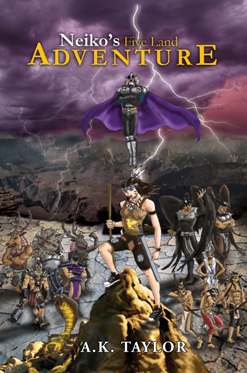
Neiko’s Five Land Adventure: This is the first book of the entire series, but two prequels will be written later that go into all the stuff that happened before to where they connect here in this book. Neiko, an 18 year old warrior is known as the Chosen One in the hidden Indian land of Hawote that coexists with the US, Canada, and Mexico. Neiko’s enemies, Raven and Bloodhawk come up with a scheme to take her out of command so they can abduct her. During the unfolding of the plan, the fantasy world that she believed she created is real. Ramses, a villain from Qari, one of the Five Lands, pays her a few visits and traps her in Qari. She must find her way back to Hawote to thwart her enemies and expose the phony chieftain who is a spy.
 I will include my paperback ISBN 10: 1936198851 even though this book is also available for kindle and EPUB. All editions of my book can be found on Goodreads, Librarything, my website http://www.neikos5landadventure.net/, and Amazon.com, and you can Google my book. The book can also be found other book and eBook retailers. I am also on the gaming site Freado.com that I give away kindle editions from time to time and people can also buy from there. I also will do giveaways on Librarything for ebooks. I am also listed on http://www.published.com/
Escape from Ancient Egypt: In the wake of the battle in Neiko’s Five Land Adventure Francesco, the exposed and scorned phony chieftain and traitor, collects on a debt of revenge against Neiko by sending her into the past in ancient Egypt during the reign of Ramesses II the Great. He was also responsible for the mysterious disappearance of four of her friends eleven years ago. Neiko finds three of them but they have to find one more. They journey to Thebes to find him. After a turn of events, Neiko is discovered and pursued by Ramesses. Francesco also comes into the picture and tries his best to push Neiko into Pharaoh’s arms for personal gain. Francesco has a fetish obsession and admiration for Ramesses as well. They must find and capture Francesco and thwart Pharaoh, but the odds are stacked against them severely as they go up against one of greatest military leaders of Egyptian history. There is also an underlining storyline here that also drives the story and is hinted at in conversation and actions and it is the reason why Ramesses and Sito, the friend that is found in Thebes, hate each other. This underlying story is revealed in book 3 Black Hand Vacation but it is kept from Neiko for a long time. This Black Hand has nothing to do with the group that started WWI, but it is an Indian terrorist group and secret society in Hawote.
 The ISBN 10 for the paperback is 144159857X. It is only available at Amazon.com and other book retailers. Presently there is no eBook or website, but as I mentioned earlier, I am going to get this redone and have the same extensive networking as “Neiko” does after it is re-released in 2012. It will be available until I begin the publishing process for the new edition, which will include eBooks.
The newest book I have worked on that may be available this year is called Self Promoting and Survival Tips for Newbie Authors, which is my only nonfiction book at the moment. This is a small eBook about some of my discoveries and ideas of unconventional methods to promote books and the authors themselves. I wrote this during a cooperative project with Mark Levine, the author of The Fine Print of Self Publishing. I hope that it will be available this year sometime and I will be involved in other work too during the course of the project.
I wrote Black Hand Vacation last year and I am working on book 4 Ramses Vs. Hawote, but altogether I have completed 11 more books in the Neiko series and I am working on two more, and one of them is book 4, and yet I’ll still keep writing. I am not sure when these others will be released but I am hoping it will be one after the other someday.
How do you come up with the names of places and characters in your books?
Some names for characters and places just jump in there and if it sounds cool and I like it; I use it, if not, I trash it. Others were made by playing with words. I would do this “word bending” as a kid for fun or mispronounce words on purpose or turn some around backwards. Some mundane words can sound really cool reversed. The pretend Indian language Greyhawk that Neiko’s tribe speaks is really just backward English, but if you try speaking an entire sentence with each word backwards it gets very difficult and it sounds like a foreign language. I have spoken this way since I was about 10 so I can do it very easily. Some Indian names are the “phrase names” used by Indians back in the past like Yellow Arrows or Grey Wolf. Attack Pack names were like some of the toy names for the action figure series but my characters were very much different than the originals. Some names are of real people like Ramesses II for instance. The Qari pharaohs may have the same names as some Egyptian kings but their meanings are much darker and insidious than original meanings, but this is mentioned later in more detail in book 3.

How did you develop the character of your protagonist in this book?
The protagonist Neiko is basically myself. I based her off of my tough side and made her a hard-core tomboy like myself. She does the things I like to do and says things much the same way. I do not put as much of my intellect into her as I do a couple of other characters. I do put in my tendency to explore, which gets her into trouble quite a bit when she snoops and finds something that has been hidden a long time.

What about an antagonist…is there a unique “bad guy” or a recurring nemesis of any kind?
There are a several of them actually, but the biggest one is Ramses, the Dark Pharaoh. Neiko’s Five Land Adventure goes into what that is slightly but more is found out as the saga continues as Neiko makes new discoveries, and it is more than a title; it is an entity. He is the ultimate nemesis, and his kind is much more evil and worse than a demon or a devil. That is the best I can describe it without spoiling too much. Raven and Bloodhawk are reoccurring bad guys and what is different about them is their towering stature, wings, eyes and feet that are like an eagle. This is due to a curse on the Crackedskulls from a long time ago due to their bloodthirsty and conquering nature. There are a few more as well…

What is your favorite thing about your book?
Hmmm, well, I guess my favorite thing—or things—about it are that it is the start of something in many ways than one. It was the start of my book-writing career, and it is the start of a new series, and it is the start of my published author career. This is also the first book that I was able to hold in my hands as a published book and not a word document that has languished on three computers for over a decade.
How is writing in the genre you write, different than other genre?
Writing in fantasy lets you create your own world and others, which I am good at and have done since I was very small. In other genres you can do this to an extent, but certain criteria within some genres rather limit you. For example, if you were going to write a story based on a real town somewhere in the US where something fictional happened, you would have to do a lot of research of that town as opposed to making up everything about a made up town, but it can have some of the customs of the area. Many authors like more structure to their settings, and I do not dock them for that. They do great jobs researching their real places and writing their stories. I am just a bit different though, but I have done that as well. I do write other books in real places that I have researched and liked. Ancient Egypt is one and the Congo River Basin, the Bayous of Louisiana, or Canada’s wilderness are others just to touch a few places I have been already, but I’ll say most of them are remote areas.
Why and when did you begin writing?
I had begun writing small stuff since middle school, but the idea of writing a book came at age 16. I thought that writing a book would be a new challenge for me and I needed a means to come back to my fantasy world that I have had since age 4. My age and society said, “You can’t play with toys anymore” so I had to think of something to be able to return to it so I wrote a book about it on my parents’ decrepit computer that they had in their room. I had to act out the stories in my head instead of with toys or solo RPG. I had to teach myself how to write a book by looking at books I had read and some of the grammar basics I learned in school such as: parts of a story, the writing process, and a brief intro to dialogue. They do not teach you how to write a book per se, and I knew no one to ask since I did not know anyone who wrote a book. Once I started, it was much easier than I thought. The fantasy world had two parts, which was “Hawote” and “The Five Lands,” so I wanted to combine them, so I did. These worlds had their perspective parts out in the woods, in the back yard or inside and outside any house where I would play.  As the book took shape and moved more, more ideas came and the fantasy world grew like never before, and then my imagination inspired a younger cousin where we made more stories and helped grow the world even more. Once this book was born, a new saga was born. When I started writing, I never thought about publishing it; I wrote for fun and as a release because high school was not kind to me socially, so I spent most of my time with family or alone; writing transformed my lonely time to constructive time. I wrote a post on my blog about this not too long ago as I reminisced about it. I was actually socially challenged and I rejected my whole school career except for college.  It was not my choosing, it was chosen for me because I was a different, deep, and brooding child. How many four year olds ask their mothers, “Do fish drink water?” or questions about why words are they way they are like: we have mice and lice, so why don’t we have hice? Or mouses, louses, and houses instead?” just to give you a glimpse of the depth of my thoughts. The question about fish was never answered until college biology and I found out why—in case you’re wondering, the answer is yes. Family and friends started to read the stories over my shoulder as I wrote and they begin insisting I publish. Strangers come into the picture too later on and say the same thing.  I did not know where to begin on that and that is a whole story in itself. My parents could not help but peek because I kept them up at night as I pounded the keyboard into the wee hours of the night until I bought my own computer five years later. I remember back with a giggle about them telling me ten times “Go to bed!” I would always say “Let me get to a stopping point,” or “Let me finish this thought,” or “Let me finish this sentence/paragraph/chapter.” Sometimes that stopping point never came until the next “go to bed” plea.
What is your writing schedule?
My schedule fluctuates. I write posts on Facebook, Twitter, my blog when I want to make a new post, email the people I need to email, or if I am working on a questionnaire like this one, I try to devote the day to it, or I write in my newest book. I write something every day. If I cannot get to my computer because I am doing something else, I am brainstorming instead. I can brainstorm everywhere. I have written so much during and after college that my laptop keys have been worn smooth and shiny—lol.
What projects are you working on now, or plan for the future?
I briefly mentioned book #4 Ramses vs. Hawote, but I am also working on one that occurs later in the saga called Residing Evil. I plan to go back and fill in where I skipped around in the saga and/or make improvements to the other books I want to change before they become published. I am also working in that project with Mark Levine I mentioned earlier that includes an eBook, but at the present, I am in a waiting period, but it will come soon. Once “Egypt” is redone then it is going to be getting each new installment published one by one or whatever I can do since this saga will be at least 30+ books, but that is the future.  Right now I am working for and earning the readership and loyalty of readers as I go, and I may have other surprises that I don’t know about in the future too, so who knows? I am just taking it day by day.
What kind of advice or tips to you have for someone who wants to write and get published?
One of the things I could tell writers is to wherever you are at, take it day by day and do not look at the big picture or the future too much or you will get overwhelmed. When you write there is a big hill to climb that has three big parts that have little parts to them: writing, publishing, and marketing, but take it step-by-step and day-by-day. You will accomplish more that way than looking at it and trying to look at the hill in its entirety and freaking out even before you get to the top. This one is cliché, but it is not unimportant: do not give up; keep writing or keep going in the direction you are going if it is good for you. Thirdly, research, research, research, this goes for anything besides science. You have to research everything from how to write a book, your setting or person you are writing about, who your publisher will be and to make sure they do good business and are trustworthy, how to market your book, or how to conduct yourself in certain settings like book signings. This is one of the many points I hit on in the eBook I wrote for the project with Mark Levine, and it is every important and worth mentioning now. Lastly, read. Reading helps you write better and it is how you do research too, and if you read a bad book, you know what not to do in your own book and recognize why you did not like it. I saw this on a writing blog, it makes sense, and it seems like common sense too.
Are there any other comments, advice or tips that you would give to beginning writers?
One comment I can think of is for younger writers out there: start writing as soon as you can! There is no age bar you have to reach when you can start—writing is actually the easy part, publishing is mediocre, and marketing is brutal and hard. Publish young too to get a good start on your career, if you think you can handle it—I did. I made my first attempt at big houses at 21, but I tried anyway even though I was turned away. I made it 7 years later as an independent author, which was a blessing in disguise even though the first run stunk. You do not have to wait until you are 40 to publish—I didn’t. I did it as soon as I was able even though I made a couple mistakes along the way, but who doesn’t? I can relate my mistakes so others do not make them and that is what author cooperation is all about. Learn all you can from people before doing your own research if you know someone. For me, I had to learn just about everything on my own because people I know knew nothing about writing and publishing and least of all marketing a book. I had to find people later on. Normal marketing strategies businesses use to sell products can work for books too. A book is a product; an author is a business and a brand, so authors are entrepreneurs and you become a business who promotes and sells its product(s). I have seen this mindset spoken of before, but I had already had this mindset before I saw others talk about it. I also mention this in my eBook “Newbie Authors.” This mindset has become very important and is often missed!
What do you do when you are not writing? 
When I am not writing I engage in my other activities, which are plentiful and well rounded. I spend a lot of time outdoors doing things or engaging in outdoor sports.  I go on hunting/fishing trips with my husband. My dad and I are small time beekeepers and we are oftentimes working together on a project of some sort like: hive maintenance, honey harvest and extraction, or removing a hive from a house, catching a swarm, and we have had the privilege to train a novice beekeeper I went to school with and start our own little group. I also am gardening or going for a walk in the woods or canning and preparing homemade foods. I plan to experiment with soap making candle making and other things too. I also like going to do target practice from time to time. My husband and I are also amateur herpetologists (science of reptiles and amphibians). We rescue, read about, and study different species of snakes, lizards, turtles/tortoises, and amphibians and we have all the catching equipment too. We love all animals, and in case you are wondering, I have pet snakes. Some of these things can include brainstorming from time to time. My biology degree has come
in handy in beekeeping and herp culture and apiology (science of honeybees) and explaining/understanding the biology to my husband and father. This has helped me talk about the scientific side of my mother’s home-based nutritional business and the biochemistry and chemistry behind it, which she uses in her presentation.

What “Made It” moments have you experienced in life?
 Some of them include, I made it through school, I made it through college, I made it to a professional lab job, which unfortunately I no longer have due to the recession, and I made it to being a published author. I also made my dream of writing a book happen. I can call that book mine because I “made it.” I can say that one over a dozen times now even though most of them are not published yet. I have several “made its” on other interviews I have been able to do. I even “made it” into a few bookstores to do signings, but now those are slowly tanking out as the industry is changing. All that tells me I have to find other creative means to “make it” and make more “made its” for the future!

What was the place you grew up like and what did you do?
The places I grew up in was extremely rural; if I took you there you would wonder how to get back to civilization and you knew that you in the middle of nowhere. My very young years were in the foothills of the mountains close to South Carolina and we lived near a river. We moved across the state to another rural place close to Alabama. My middle years were in the suburbs, which I hated. I now have returned to the backwoods in middle Georgia where I live today. We had neighbors but we could not see them when we lived out in the backwoods. I had hundreds of acres of woods as a personal playground, and our yard was like five acres itself. When we moved to the suburbs though I had about an acre—oh that was like jail to me.  I never worried about snakes or other wildlife too much when I was out in the woods, but I did look out for them. When we lived on the river we would go into town and buy a bucket of worms and some snacks, go fishing all day and walk up the steep hill home. We would swim in the river with the snakes and all, but we did not care too much. Sometimes the bream would nibble on your toes and you would step on a catfish which hurts, sometimes we would bring home some of the small freshwater clams and keep them for a time. To add when we lived in the foothills I was the only girl in my kindergarten class to hold a king snake and get a certificate of bravery. I believe this is when my fascination with snakes began; I had already been catching big fat toads, frogs, and lizards already.
Where can readers and other authors find you?
Facebook: www.facebook.com/AKTaylorsBooks I have widgets to Bookbuzzr and Goodreads on this fan page on my wall
Blog: http://www.backwoodsauthor.wordpress.com/ I write about my experiences and life in the backwoods. I have widgets for freado and bookbuzzr on my blog and a link to one of the hangman games I created here too. I will try to put one for Goodreads later on.
Other sites:
http://www.bookbuzzr.com/ and http://www.freado.com/ Bookbuzzr hosts the gaming site Freado where readers can win and/or buy books including “Neiko”
Shelfari, Librarything, Goodreads: I am an official author on each of these sites so people should find me.
The Book Marketing Network, http://thebookmarketingnetwork.com/
Local newspaper article: http://waltontribune.com/news/article_03f7399e-2959-11e0-a343-001cc4c002e0.html?mode=story  picture with me holding the book.